Black Cat Energy Script Vector Design
A Designer’s First Look: Moody, Minimal, and Made for Meaning
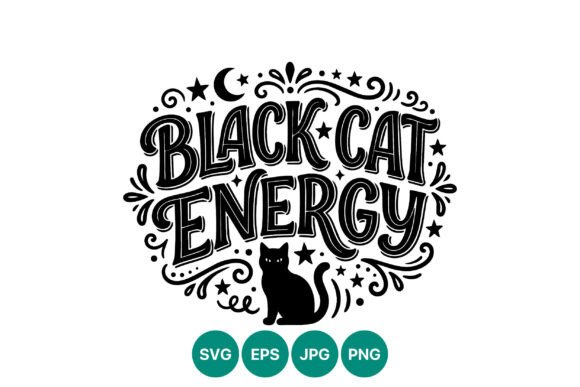
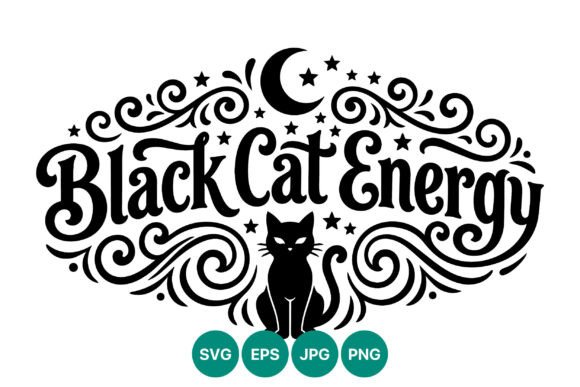
When I opened the Black Cat Energy Script Vector Design, what struck me wasn’t just the clean black-and-white contrast—it was the quiet confidence in its composition. A sleek silhouette of a seated cat anchors the bottom, while “black cat energy” flows above in a relaxed, hand-drawn script. Crescent moon and tiny stars orbit the phrase like subtle cosmic punctuation. It doesn’t shout. It hums. That’s exactly why it works so well for handmade products where personality matters more than polish—think embroidered tote bags for indie bookshops, minimalist sweatshirts for witchy wellness brands, or nursery pillow covers that whisper rather than announce.
Where This Design Truly Shines (and Why Your Customers Will Notice)
I tested the Black Cat Energy Script Vector Design as the focal point on a natural linen tea towel—and it landed perfectly. The script’s generous letter spacing held up beautifully in satin stitch, and the cat’s smooth outline translated into crisp, confident fill stitching without jagged edges or overworked corners. Because it’s built as vector art, scaling worked predictably: 3.5" wide for a baby onesie collar? Clean. 6" wide across a canvas tote? Still balanced, still legible. It’s especially strong for small business merchandise where brand tone is soft but intentional—like an Etsy seller offering personalized gifts for cat lovers, spiritual seekers, or introverted creatives. The design feels handmade *without* looking amateurish, which builds trust faster than any tagline.
- Custom apparel: Works best on mid-weight fabrics—cotton blends, fleece, structured knits. Avoid ultra-thin tees unless you reduce density and add lightweight stabilizer.
- Embroidered patches: Ideal candidate. The clear silhouette + open script gives plenty of breathing room between elements—no risk of thread piling up in tight zones.
- Baby embroidery: Gentle theme, no fussy details—great for onesies or burp cloths. Just confirm your thread colors are Oeko-Tex certified if selling commercially.
- Holiday or gift embroidery: Surprisingly versatile—pairs well with velvet stockings, wool felt ornaments, or even ceramic mug transfers (when used digitally first).
Where to Pause—and Test Before You Commit
This isn’t a “drop-in-and-stitch” file for every surface. The script’s delicate curves and the cat’s tapered tail demand attention on textured or stretchy fabrics. On terry cloth towels or ribbed knit caps, I saw slight distortion in the finer strokes during my test run—nothing a tighter hoop and cutaway stabilizer couldn’t fix, but definitely worth checking. Also, avoid placing the full design near curved seams or deep armholes; the crescent moon and stars sit close to the script baseline, so they’ll compress awkwardly if stretched over a rounded shoulder seam.
And here’s something practical many overlook: the stars are small. Not microscopically tiny—but small enough that under 4" width, they risk becoming indistinct blobs in fill stitch. If you’re planning a cap front or pocket-sized patch, consider simplifying or omitting them manually—or lean into negative space and stitch only the cat + script.
What This Design Says About Your Craft Business
Using the Black Cat Energy Script Vector Design thoughtfully tells your customers you value intention over trend-chasing. It reads as curated—not generic clipart. That nuance lifts perceived value: a $38 embroidered apron with this design feels more like a keepsake than a promo item. For Etsy sellers, it adds quiet storytelling to listings (“for the quietly magical,” “for those who recharge in solitude”)—which boosts engagement far more than flashy fonts ever could. And because it’s delivered as SVG, PNG, JPG, and EPS, you can adapt it beyond embroidery: use the PNG for printable mockups, the SVG for Cricut vinyl decals, the EPS for packaging labels. It’s not just a machine embroidery design—it’s flexible design assets.
Real Embroidery Designer Notes (From My Hoop to Yours)
Before stitching your first customer piece:
- Test the Black Cat Energy Script Vector Design on scrap fabric *identical* to your final product—especially if using dark fabric. Black-on-black won’t read, and white thread on cream linen needs extra density to avoid transparency.
- Review stitch density in your embroidery software. The script’s thin strokes can look fragile if under-digitized. Add 5–7% density if your machine allows fine-tuning.
- Check hoop size compatibility. The full layout fits comfortably in a 5x7 hoop—but if you’re resizing down for baby items, confirm your smallest hoop clears all elements cleanly.
- Inspect small details at 200% zoom: Are star points sharp? Does the cat’s ear taper cleanly? If not, a quick vector cleanup in Illustrator may save rehooping later.
- Always test thread color contrast—not just on white, but on your actual fabric base. What reads bold on screen can vanish mid-stitch.
- Confirm licensing terms before selling finished items or digital products. Since this falls under Illustrations and Graphics, commercial use is likely permitted—but verify before listing on your craft platform.
Final Thought: Less Is Honestly More Here
The Black Cat Energy Script Vector Design earns its place in my working library because it respects the materiality of embroidery. It doesn’t fight the medium—it leans into its strengths: line, contrast, rhythm, and restraint. It’s not for loud logos or corporate swag. It’s for the maker who chooses a cat motif not as cliché, but as quiet kinship. Use it where stillness speaks louder than saturation—and your customers will feel the difference in every stitch.