Catnap Society Sleeping Cat Vector
A Whimsical Whisper—Not a Shout
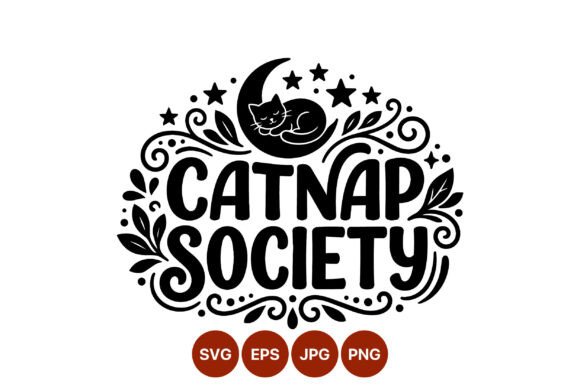
First impression? This isn’t a bold, in-your-face embroidery file. Catnap Society Sleeping Cat Vector lands softly—like a cat settling into sun-warmed fabric. The black-and-white illustration leans into quiet charm: a curled sleeping cat on a crescent moon, delicate leaves and stars orbiting the phrase “catnap society” in gentle, hand-drawn lettering. It’s not cartoonish or overly detailed; it’s *breathable*. That matters—especially when you’re stitching it onto a linen tea towel for a boutique kitchen line or embroidering it onto a cotton baby onesie where subtlety reads as tenderness.
Where It Lives Best (and Why)
I recently tested Catnap Society Sleeping Cat Vector as the centerpiece for a custom embroidered canvas tote bag—intended for a local indie bookstore’s staff gift set. The design scaled beautifully at 4.2 inches wide. Its clean outlines and open negative space translated cleanly into satin stitch borders and soft fill stitch for the moon and cat body. No crowding. No thread piling up in corners. On medium-weight natural canvas with tear-away stabilizer, every leaf tip stayed crisp, and the crescent’s curve held its shape without distortion.
It also worked surprisingly well on a lightweight organic cotton sweatshirt—though only because I used a light cutaway stabilizer and reduced stitch density slightly in the star cluster. That’s key: this isn’t a heavy-duty machine embroidery design built for dense fleece or thick twill. It shines on breathable, stable fabrics—linen napkins, chambray aprons, cotton pillow covers, gauzy nursery swaddles, and unstructured caps (flat-front panels only).
Etsy sellers will appreciate how naturally it fits into curated collections: “whimsical nursery decor,” “slow living gifts,” or “bookish handmade goods.” As a digital embroidery file, it invites thoughtful pairing—not flashy layering. A single Catnap Society Sleeping Cat Vector on the chest of a cream-colored sweater says more than three competing motifs ever could.
Where to Pause—and Test First
Don’t rush this one onto stretchy knits or textured terry cloth. The fine stems of the decorative leaves and the thin serifs in “catnap society” can blur or skip on unstable surfaces. I tried it on a ribbed cotton baby bodysuit—lovely concept, but the lettering softened under tension. Same goes for curved cap fronts: unless you’re using a specialized cap hoop and very low-density fill, the crescent moon’s arc may warp slightly.
Also note: the black-and-white nature means contrast is everything. On dark fabric, white thread must be bright and matte—not glossy—to preserve that hand-illustrated feel. On light fabric, black thread needs richness, not grayness. Always test your thread colors on scrap first, especially if you’re selling finished products. Customers notice when “midnight black” looks like charcoal.
Small Hoop Realities
If you’re working with a 4x4 hoop, you’ll likely need to resize down to ~3 inches wide. That’s doable—but inspect the tiny stars closely in your embroidery software. Some may collapse into single stitches or vanish entirely depending on your machine’s minimum stitch length. Zoom in. Run a simulation. Better yet: stitch a test version on muslin and hold it at arm’s length. Does the “society” still read clearly? Does the sleeping cat retain its sleepy posture—or flatten into an abstract blob?
What It Adds to Your Handmade Product (Beyond Aesthetics)
Catnap Society Sleeping Cat Vector doesn’t just decorate—it signals intention. When stitched onto a handmade ceramic mug cozy or a linen pouch sold at a craft fair, it tells buyers: *this was chosen carefully, not slapped on.* That builds trust. It elevates perceived value without demanding premium pricing. For small shop owners, that quiet confidence matters—especially next to busier, trend-chasing designs.
It also plays well with branding. If your shop voice is warm, unhurried, and gently poetic, this vector reinforces it. It won’t clash with soft color palettes or natural material photography. And unlike overused paw-print motifs, it stands out in search results and printable mockups—making your Etsy listing or Instagram post feel distinct, not derivative.
Practical Notes from the Hoop
- Always test on scrap fabric matching your final product’s weight, weave, and stretch—even if it’s just a 2-inch square.
- Review stitch density before sending to your machine. High-density fills in the moon or cat body can cause puckering on lightweight cotton.
- Confirm hoop size compatibility. The original vector may be large; scale thoughtfully—not just to fit, but to preserve legibility.
- Inspect small details in your embroidery software: star points, leaf tips, and letter spacing. Adjust underlay or reduce pull compensation if needed.
- Try black-and-white mockups on both light and dark backgrounds. Does the phrase “catnap society” stay readable at 3x zoom? At 10 feet?
- Use appropriate stabilizer: tear-away for stable wovens, light cutaway for knits, and no-show mesh for sheer fabrics.
- Verify licensing terms before using in commercial embroidery, client work, or digital product previews. Since this is listed under Illustrations and Graphics, confirm whether the ZIP includes editable vector files or only raster-based embroidery formats.
Final Thought: A Design That Rests Well
Catnap Society Sleeping Cat Vector isn’t for every project—and that’s its strength. It’s not trying to dominate. It’s designed to settle in, to complement, to invite a second look. In a market flooded with loud, complex, over-digitized embroidery files, this one earns its place by being quietly capable: easy to digitize further, forgiving to stitch, memorable without shouting, and versatile enough for baby embroidery, holiday embroidery, and everyday small shop merchandise alike.
Just remember: whimsy works best when it’s intentional—not accidental. So slow down. Test. Tweak. Let the cat sleep a little longer while you get it right.